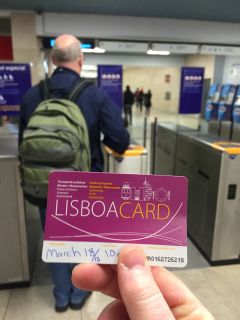
So we awoke to the sounds of track and the warm light of dawn as we trickled toward Lisbon in the early hours of Wednesday. Arrival was at 7:30 AM… and we quickly grabbed two Lisboa Cards at the conveniently located office in Santa Apolonia Train Station. We leveraged these cards for all types of public transit and access to free or discounted entry into multiple Lisbon attractions. We got great mileage from them as they worked for train, subway, trolley, lift and funicular without incident. For us it was a solid deal!
Unfortunately, we arrived finding the Metro was facing a short work action (strike) that was scheduled to run until 10:00 am. Thus, we stowed our bags at the station and set out on foot. It was nice to stretch the legs after the train trip (I noticed the same rocking feeling I get after spending time on a boat). Further, the line ups for buses were obscene. We walked along the river to Commercio Square and Rua Augusta, the main pedestrian thoroughfare of the city. It seemed lively, refurbished and part of the city core.
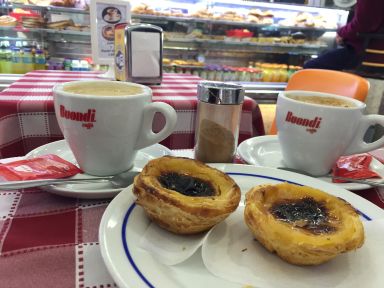
On Rua Augusta we decided to stop for breakfast. Coffee and Pastels de Nata were the choice, and both were hard to beat! The pastels de nata were amazing little pastries that were nothing short of delicious. Janie, in the meantime, had jammed into local wireless and pulled up a rusty website that she managed to capture several screen shots from… each with a few words of Portuguese that we might be able to sling in our best maritime English accents. Obrigado (o-bri-ga-du)… thanks!
Pulling out the map that came with our Lisboa cards, we headed up hill, towards the Sé de Lisboa (Lisbon Cathedral). We arrived just before opening and sat on a bench checking out the ceramic roof tiles that are such a common piece of the region’s architecture. Once inside the Cathedral, the oldest church in the city, we toured the nave and alter areas. The centuries have worn both the interior and exterior, and earthquakes have severely damaged the structure several times. Portugal, like much of Spain, is heavily anchored in the Catholic faith.
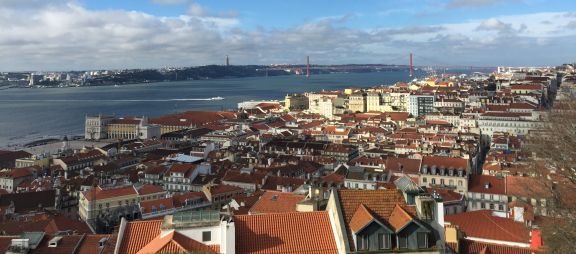
Following the handy brown street signs, we continued uphill towards Castelo de São Jorge, the ancient castle that overlooks much of the city and is visible throughout the region. Although mostly ruins, the site is probably most well known for its excellent view of the city below. We walked most of the grounds, climbed castle walls, were sociable with the peacocks and enjoyed trying to pinpoint where our accommodations were located below. We ended the visit with a light lunch which we had packed… listening to music in the street below and watching the birds mill about for crumbs.
Lisbon has become famous for the old school trolleys that still frequent the winding streets in older parts of the city. After tumbling down from the castle, we hopped on Tram 28E, and toured the Alfama neighborhood. Kind of a step back in time in many ways. The trolleys, with the old bells, rickety tracks and creaking floors, made me think of Gordon MacKenzie. He would have loved watching the operator get up from the front seat with his metal handle, only to walk to the back to move the car in the other direction. So cool… The route took us around to the very stop we would use to and from our accommodations, Figuera Square.
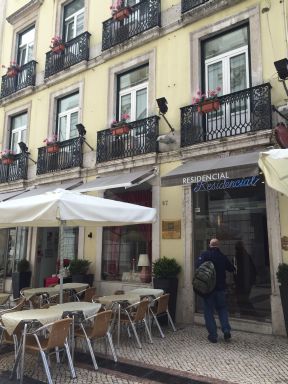
Being so close, we tried our luck with an early check in at Residencial Florescente, our Lisbon accommodation. Low and behold… all ready to roll. Without bags (still at train station) we quickly looked around our digs and once again, loved the location and proximity to transit, stores and attractions. Great spot for a few nights, and our appreciation for the smaller boutique hotels continues!
We hopped on the nearby Metro, gathered our bags at Santa Appolonia Station and returned to drop them off. After a short afternoon break, we headed to the north of the city via subway to visit the Museu Calouste Gulbenkian. The Gulbenkian came highly recommended in several guides, not only for the quality of the collection, but also how it is presented. We gained access and explored the exhibits in a totally unhurried fashion, as crowds were non-existent (This is often true of museums on Wednesdays vs weekends). The museum flows chronologically, as Art from the antiquities are the first exhibits, including sculpture and pottery, through to an impressive collection of European Renaissance masters. The pace, presentation, and sheer quality of the work makes this museum a real hidden gem! I especially liked Rembrandt’s Portrait of an Old Man, Renoir’s Portrait of Madame Claude Monet and Sargent’s Lady and Child Asleep in Punt Under the Willows. Unlike the Prado, this was a very manageable collection of art for visiting.
After a fine visit, we caught the next subway car home and headed back to the Florescente where I ran out of steam. Janie, on the other hand, went walk about and found a local grocery store, and did some shopping for fruits, veggies, wine, and, interestingly, tinned seafood. Gourmet sardines rule in Lisbon! Upon her return we snacked, enjoyed some wine, got cleaned up and headed out to see what Lisbon offers after dark.
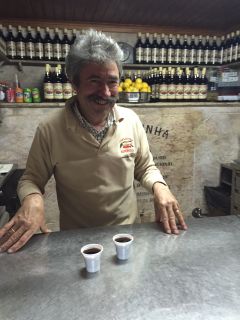
Just a block from our hotel, we found a Ginjinha bar. Ginjinha is a cherry liquor sold to people on the street from small bars and stores (you can purchase with or without the seeds). Tasting a bit like a sweet cough syrup, we had shots while listening to buskers near Rossio Square. Our neighborhood, the Baixa-Chiado area, was totally rebuilt following an earthquake in 1755. The use of tile on buildings became popular during this period of rebuild. The wide, pedestrian streets are designed with shops and walkers in mind, fancifully designed with waves of ceramic tiling. We strolled the area, and felt safe at all times amid the families and revelers that flooded the streets.
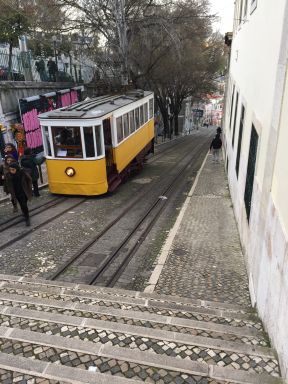
That evening, we explored the local area and, at Restauradores Square, caught the Gloria Funicular to the Bairro Alto neighborhood and Miradouro (Viewpoint) de São Pedro de Alcantara, directly across the city from Castelo de São Jorge. Excellent look out across the expanse of Lisbon. The funiculars, of which there are several, that chug up and down the steep streets carrying pedestrians and tourists are a real treat. We traveled on the one nearby several times… saved a bunch of uphill steps!
Of note, we tackled Santa Justa Lift, a street elevator which took us aloft. Although under construction, it provided a birds eye view of the streets and an easy ride uphill. From here we strolled toward the waterfront and Commercio Square ending our evening with a short ride back via the Metro. Our first day in Lisbon had been exhausting, and we had gotten to see most of the attractions we had hoped to visit!